Texas vs. Colorado State Park Passes: What Ours Actually Saved Us
When I added up what my Access Pass had saved us, the number was smaller than I expected. The reason was simple: most of where we camp is state parks, and federal passes don’t work there. So I went back through every state park receipt from the last year, Texas and Colorado, to see what the state passes actually did for us.
Short version: both paid for themselves, one of them by a lot, and we left money on the table in Texas before we knew better.
Texas: the $70 pass that paid us back three times
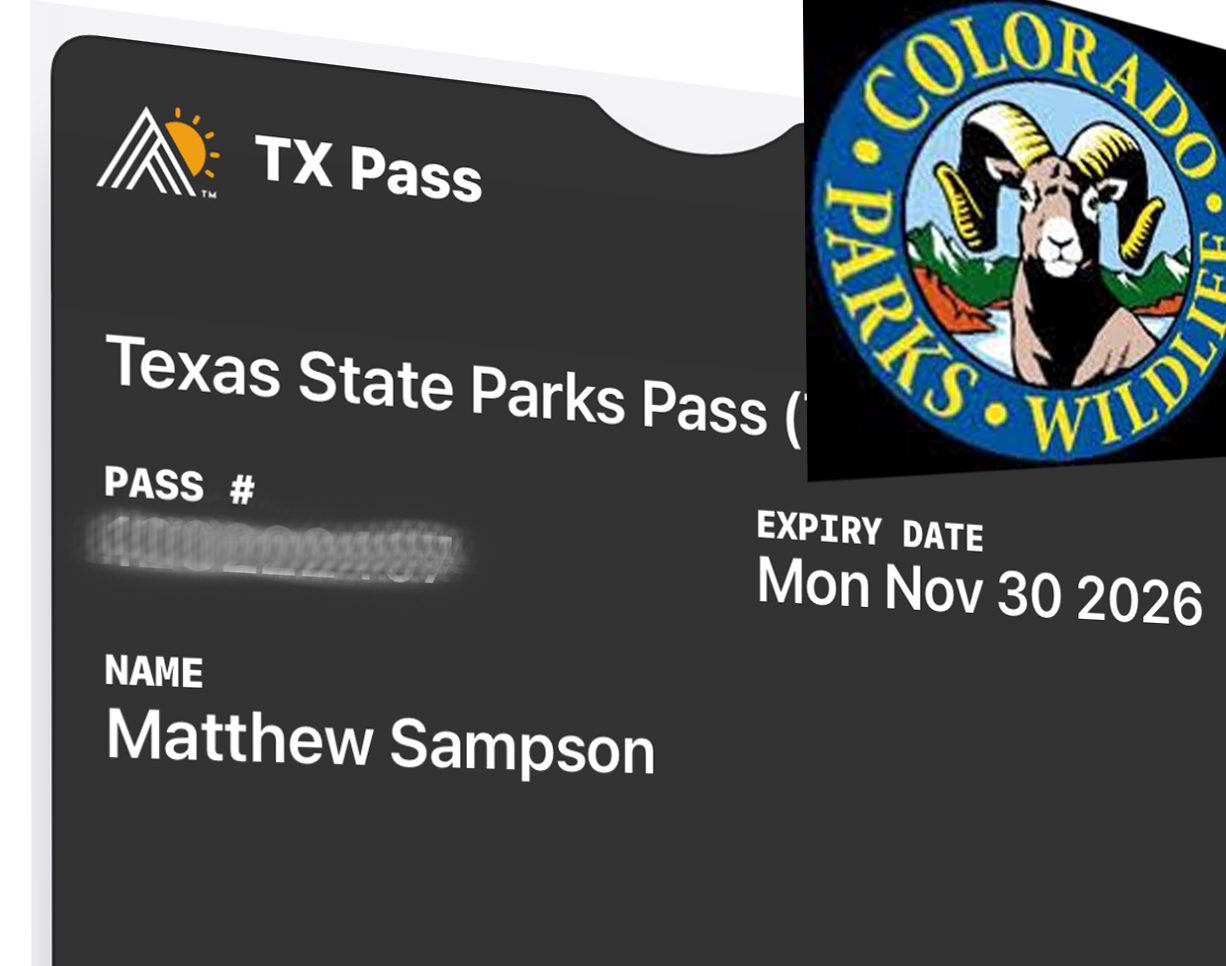
The Texas State Parks Pass is $70 for a year. It’s issued to one person, and that person has to be there, but it covers everyone riding in the car with them. You can add a second card for someone at the same address for $25.
What it does:
- Free entry for the cardholder and the whole carload. Texas charges entrance per adult, per day, so for two of us that was $10 to $14 a day at the parks we visited.
- Half off the second night of camping when you stay two or more nights in the same site. One discounted night per reservation.
- 10% off most things in the park stores and rentals.
It does not cover the campsite itself. Camping fees still apply.
What it actually saved us
I bought ours on November 28, 2025, halfway through our first Texas winter in the Brinkley. From then on, across 15 nights at Goose Island, Lake Corpus Christi, Lake Livingston, Brazos Bend, Abilene, Monahans Sandhills and Palo Duro Canyon:
- $178 in entrance fees we didn’t pay
- $53 off our campsites
- $231 total, on a $70 pass.
And here’s the part that stings a little. Before I bought it, we’d already paid $118 in entrance fees at Davis Mountains, Guadalupe River, McKinney Falls and Goose Island. Add the second-night discounts we missed and the pass would have saved us another $140. Bought on day one, that one $70 card would have been worth about $371 to us.
Two things I learned the expensive way
- Buy the pass before you book. Texas applies your pass benefits when the reservation is created, not when you arrive. Our first Goose Island reservation was booked five days before I bought the pass, so we paid its $20 entrance even though we had the card by the time we showed up.
- Book the whole stay as one reservation. The half-price night only comes off a reservation of two nights or more. Twice we liked a park enough to add a night, booked it as a separate one-night reservation, and got the free entry but no camping discount.
Colorado: $29 at the DMV
Colorado does it differently. The cheapest way into Colorado state parks is the Keep Colorado Wild Pass, and you can’t buy it at a park. It’s a $29 add-on when you register your vehicle with the DMV, it’s tied to that vehicle’s plate, and it gets that vehicle and everyone in it into every Colorado state park for the year. Your registration card with the Parks and Wildlife logo is the pass.
We have it on our registration. Without it, a day pass for a Colorado-plated vehicle is $10, and since May 2026 out-of-state plates pay $15 or more.
Over the last year we spent 10 nights in Colorado state parks: Lathrop, Trinidad Lake, Navajo and Mancos. At $10 a day that’s roughly $100 in day passes. So the $29 pass covered itself by about the third day.
Like Texas, it doesn’t touch camping fees. The only Colorado camping discount is $3 a night, Sunday through Thursday, for residents 64 and older (we’re not there yet, and I’m in no hurry).
Side by side
- Price: Texas $70 a year. Colorado $29 a year.
- Who can get it: Texas, anyone from anywhere. Colorado’s Keep Colorado Wild pass, Colorado residents only, at vehicle registration. Out-of-staters can buy Colorado’s regular annual pass ($80) instead.
- Tied to: Texas, the person. Colorado, the vehicle.
- Entrance: both cover everyone in the car.
- Camping: Texas takes half off the second night on stays of two nights or more. Colorado, nothing unless you’re 64 or older.
- What it did for us: Texas, $231 back on $70 (and $371 if I’d bought it on time). Colorado, about $100 back on $29.
Where the Access Pass fits
None of this overlaps with my Access Pass. That one works at national parks, national forests, BLM land and other federal sites, and it’s the better deal when we’re at a federal campground. But it doesn’t work at a single state park. If you camp the way we do, a mix of both, you want both kinds of pass in the glovebox.
Our Texas pass expires November 30, and yes, I’m renewing it. This time I’m buying it before we book anything.
See you down the road,
Matt