How I Got a Lifetime Access Pass for Tinnitus (and What It Has Actually Saved Us)
I have tinnitus, and I’m happy to talk about it. This year I found out it also qualified me for a free, lifetime pass to every national park and most federal campgrounds in the country.
So here’s the whole story: what the Access Pass is, how I got mine without ever standing in a ranger station line, what it has actually saved us (real receipts, real numbers), and the fine print nobody mentioned until we were already parked.
What the Access Pass is
The America the Beautiful Access Pass is a free, lifetime pass for US citizens and permanent residents who have a permanent disability. It gets you into more than 2,000 federal recreation sites run by six agencies: the National Park Service, the Forest Service, the Bureau of Land Management, Fish and Wildlife Service, the Bureau of Reclamation and the Army Corps of Engineers.
At an entrance gate it covers you and everyone in your car, or you plus three adults where they charge per person. At a lot of federal campgrounds it also takes a discount off your campsite, usually 50 percent. More on that “usually” in a minute.
Does tinnitus count?
It did for me, but I want to be careful here, because I’m a guy with a travel trailer, not a doctor.
The official definition is a permanent physical, mental or sensory impairment that limits one or more major life activities, and hearing is listed right there by name. It is not based on a disability percentage. Olympic National Park puts it plainly on its own website: deaf and hard of hearing visitors with the right documentation qualify.
The documentation is the part that matters. You need one of these: a signed letter from a licensed physician saying the condition is permanent and how it limits you, a federal document like a VA or Social Security disability award, or a document from a state vocational rehabilitation agency. A disability parking placard does not count.
I went with a letter from my doctor. If you think you might qualify, that conversation with your own doctor is the first step, and they’re the one who decides what goes in that letter.
How I got mine (online, in three days)
You can pick one up free at a lot of federal sites in person, and the Park Service actually recommends that. We’re rarely near a visitor center when we have time to sort out paperwork, so I did it online.
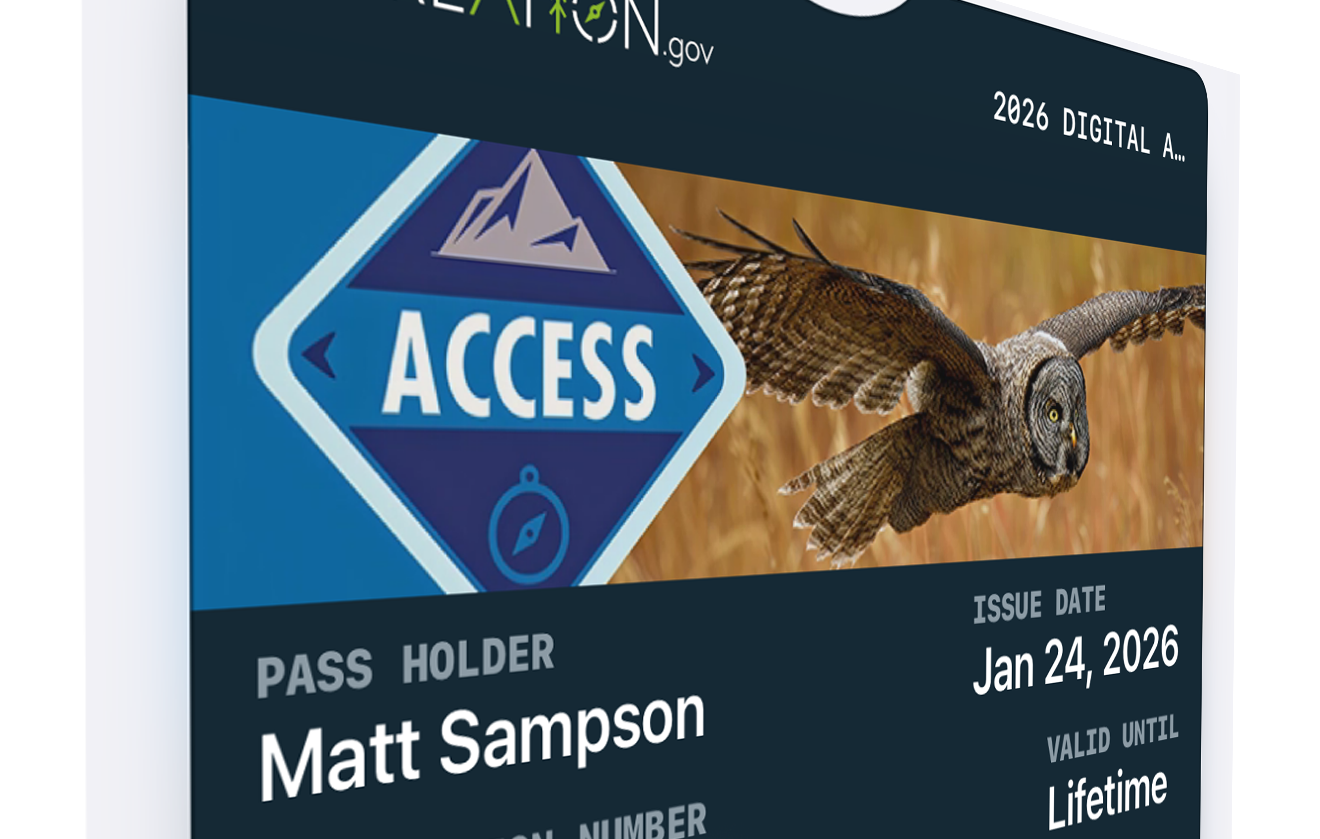
- January 24, 2026: I applied through Recreation.gov for the digital Access Pass, uploaded my ID and my doctor’s letter, and paid $7.50 to have a physical card mailed too. The digital pass itself is free.
- January 27: approved. Recreation.gov says verification can take up to 72 hours, and that is exactly what it took.
- February 21: the physical card shipped.
One tip: if you want the physical card, add it at checkout. Recreation.gov won’t let you add it later. (You can also go through the USGS Store instead, which mails a physical card for $12.50 in processing and handling.)
What it has actually saved us
I’ll be honest, I guessed this number was in the thousands. Then I went back through every receipt, and it’s not. Here is every campground discount it has given us since January:
- Pine Flat Campground, Sedona, Arizona, four nights in April: $60 off
- Penitente Canyon, Colorado, four nights in August: $22 off
- Hovenweep National Monument, Utah, three nights in September: $30 off
- Rabbit Valley, Colorado, one night in September: $20 off
- Sand Gulch Campground, Colorado, four nights in September: $40 off
That’s $172 off our campsites in about eight months, against the $7.50 I spent on the card. Every single federal campground we booked after January knocked exactly half off the campsite fee. Hovenweep for three nights cost us $30 total.
And here’s why it isn’t thousands yet: most of where we camp is state parks, and the Access Pass doesn’t work at state parks at all. Different system, different passes. For Texas we bought a Texas State Parks Pass, and that one paid for itself within about two weeks. That’s its own story.
The fine print nobody tells you
- It’s set campground by campground. Each facility on Recreation.gov decides whether to honor the discount, and privately run concession campgrounds on federal land may not.
- It only comes off the campsite fee. Reservation fees, hookups billed separately, cabins, group sites and double sites are full price.
- I have to be there. The pass holder has to be at the site, and I need my pass and a photo ID at check-in. Erin can’t take it on a girls’ trip.
- One site at a time. If friends book the site next to ours, they pay full price.
- It’s for life, and it’s mine. Non-transferable. If I lose the card, I apply again.
What’s next: theme parks
Here’s the part I didn’t expect to write. Some of the hardest places for me now aren’t campgrounds at all. They’re theme parks. The noise, the crowds, the music in every direction, it feels like everything is collapsing in on me. A few of the big parks, Universal among them, have accessibility programs for guests who need them, and we’re just starting to learn how those work. When we’ve actually tried one, I’ll tell you how it went.
Quick answers
- Is the Access Pass really free? Yes in person, and the digital pass on Recreation.gov is free. You only pay if you want a card mailed.
- Is it for life? Yes. It doesn’t expire.
- Does it work at state parks? No. Only federal sites.
- Do I need a certain disability percentage? No. It isn’t based on percentage. The disability has to be permanent and limit a major life activity, and the paperwork has to say so.
- How long did it take? Three days online for the digital pass, about four weeks for the card to ship.
If you have tinnitus, or anything else you’ve been quietly living with, it’s worth that conversation with your doctor. Worst case, you learn something. Best case, Hovenweep is $10 a night.
See you down the road,
Matt