Lake Corpus Christi
ABOUT THE PLACE
Lake Corpus Christi State Park, Texas
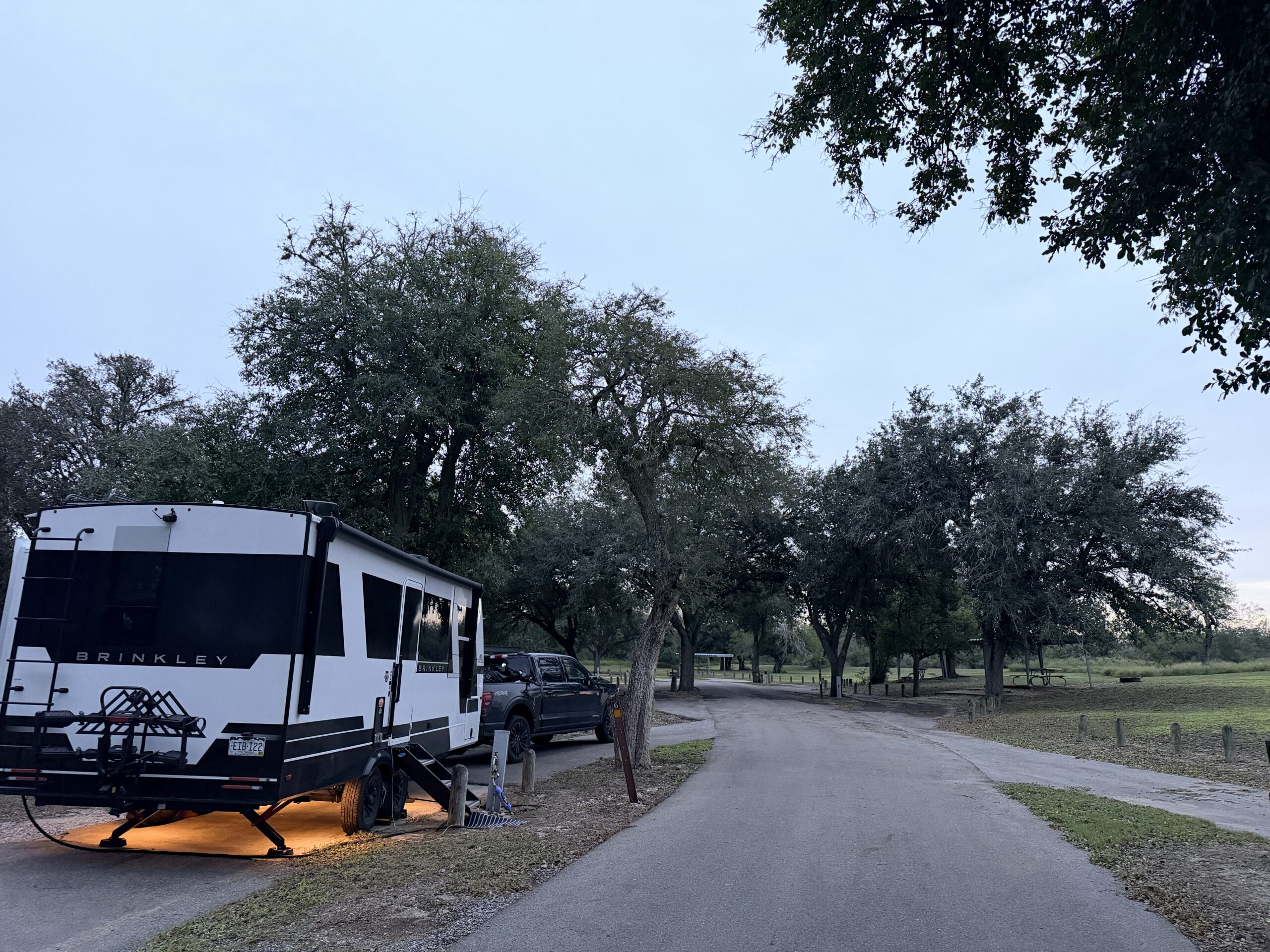
We spent two nights here in December 2025, on our Texas winter trip (Episode 6). We were in site 6 in Opossum Bend and paid $30.00 for two nights, with our Texas State Parks Pass. Our full field report is still being written, so here is what to know about the place itself.
The short version
Lake Corpus Christi State Park covers 356 acres on the shore of Lake Corpus Christi, southwest of Mathis in South Texas. Texas Parks and Wildlife describes it as a placid lake amid one of the last remaining stands of South Texas brush country.
A little history
- A dam on the Nueces River created a reservoir called Lake Lovenskiold in 1929, and the dam failed that November.
- New Deal funding rebuilt the dam in 1935 and the reservoir was renamed Lake Corpus Christi. The present dam was completed in 1958.
- The state leased the land from the City of Corpus Christi in 1934 and opened the park that year. Civilian Conservation Corps Company 886 built it between 1934 and 1935.
- The Mediterranean-style refectory, made of local caliche blocks laid to look like cut limestone, is the only CCC building left.
What it is known for
- Birding: more than 200 species have been seen here, and it is a stopover for Neotropical migrants.
- Fishing for bass, crappie, catfish and sunfish from two lighted piers, one of them 400 feet long and wheelchair accessible.
- Swimming (no lifeguards), paddling, boating and water skiing, with two boat ramps. Alligators live in the park.
Camping
- Campsites range from water only to water and electric to full hookups with sewer.
- There are also screened shelters, cabins and group sites.
Good to know
- The park often fills, so reservations are recommended for camping and day use. Weekends from late winter through summer are busiest.
- The park no longer rents watercraft, so bring your own.
- The average January low is 44 degrees, and the first freeze usually comes in mid-December. There is an entrance fee.
Facts checked October 2026. Things change, so check the official site before you go.
IN THE JOURNAL
Where we wrote about it
-
Texas vs. Colorado State Park Passes: What Ours Actually Saved Us
The Texas State Parks Pass paid us back $231 on $70, and Colorado's $29 Keep Colorado Wild pass covered itself in three days. Real receipts, and…
-
Our Snowbird RV Route: Colorado to Texas and Back
Our first snowbird winter in the Brinkley: Colorado to Texas through New Mexico, and home through Arizona. Every stop in order, with costs by state.
-
Texas State Parks in Winter: 25 RV Nights at $24 a Night
We camped 25 nights in ten Texas state parks in our travel trailer and paid $24.48 a night. Every park and receipt, plus what to know…
Field report coming soon.
the notebook is full, the page is not (yet)