How We Travel: The Mandatory Notes Every AI Reads First
This document makes most of our travel possible. It grows almost weekly as we adjust and add to it. If you’d like to use this as a starting point for your travel preferences, feel free to take as much (or as little) as you’d like! Every AI that touches one of our trips reads this before it does anything else, so nobody has to ask me the same questions twice. Claude and I built it from my old AI chats and our trip logs, plus a lot of me answering questions out loud. Whenever we learn something new, it goes in.
Ours has gotten long. Yours doesn’t need to be. Take what’s useful and change the rest.
Who’s traveling
- Erin and me, empty nesters in our fifties, self-employed for over thirty years.
- We’ve split every year between Arvada, Colorado and Tamarindo, Costa Rica since 2011. Starting in 2025, we’ve also mixed in an enormous amount of travel around the United States in our travel trailer.
- I drive, plan and shoot. Erin teaches, and she’s on camera.
- Rindo, our 13-year-old mini goldendoodle, goes everywhere with us.
- We don’t need perfect. We need real. Anything that reads as curated or generic gets rejected.
- Plans going sideways doesn’t bother us. Fifteen years in a country where roads flood and the power cuts out frequently took care of that.
There are three versions of us, and the AI has to figure out which one it’s planning for:
- The two of us in the RV. The default. State parks and boondocking, shoulder season, no hard time pressure, filming throughout.
- The whole family, eight of us. Hotels, four rooms, one to two weeks, mid-August. Everybody’s a seasoned traveler and everybody loves a thrill ride.
- The two of us overseas. Hotels, ten to fourteen days, trains over rental cars.
The rig
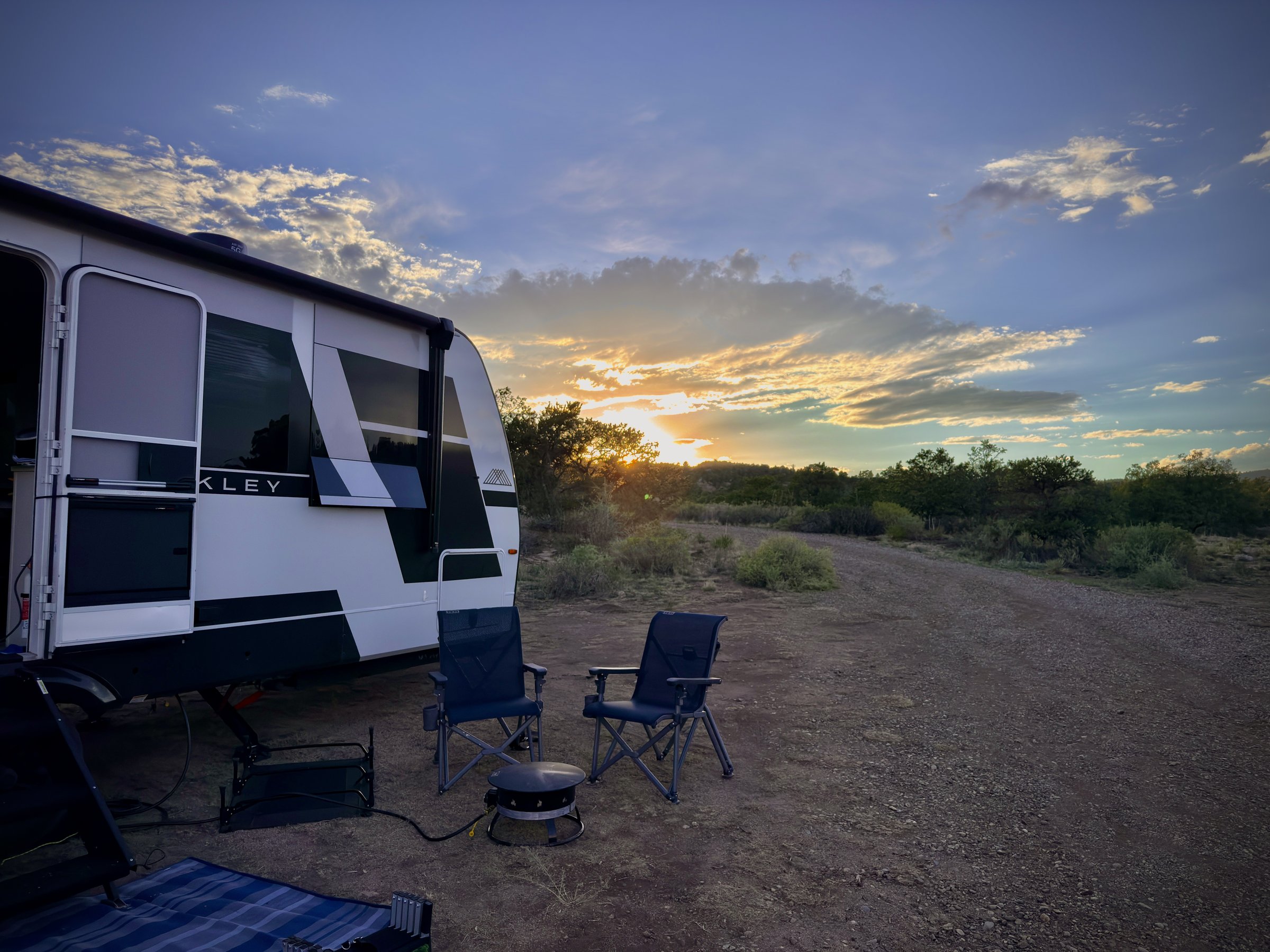
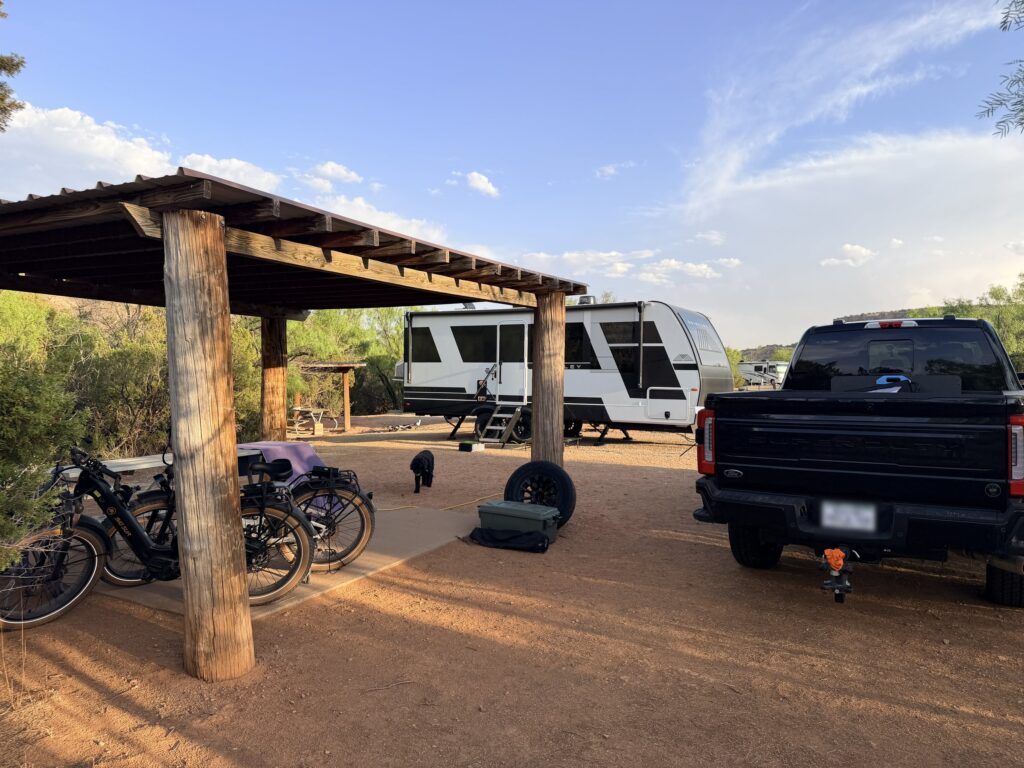
- 2025 Brinkley Model I 235 travel trailer, bumper pull, 27 feet long and 11 feet 4 inches tall.
- Ford F-250 Platinum, gas engine.
- Starlink, and a clear sky for it is a requirement.
- Lectric e-bikes, Class 2, which are restricted on a lot of trails where Class 1 is fine.
- A Blackstone griddle. In the trailer, cooking is the default.
Pace
- Two nights is the floor for a real stop. One night only when we’re getting somewhere fast.
- Three to four nights is normal. Five is fine when a place earns it.
- There’s no maximum. If a place is worth a week, make the case.
- We don’t drive every day. We need stationary days for filming and work.
Driving
- We love the 3-3-3 rule: no more than 300 miles in a day, arrive by 3 p.m., stay at least 3 nights. We don’t have to stick to it, but it’s what we aim for.
- Two to four hours is the norm. Eight hours is the ceiling, not the goal.
- Daylight only, and we arrive before dark. Work out the actual sunset for that date and place, then count back from it with setup time included.
- Scenic beats efficient when the extra time is reasonable and the road suits a trailer.
- We’d rather drive through an interesting town than around it. New Mexico routes go through Santa Fe.
- Check clearance against our height on anything that isn’t an interstate.
- Warn us about grades over six percent, long high-altitude climbs and rough pavement. Warn us about known crosswind corridors too.
- Fuel stops have to fit a truck and a 27-foot trailer. Love’s first, then Pilot or Flying J, then Maverik, listed by exit number.
- Plan dump stations on every corridor.
Where we sleep, in order
- State parks, the clear favorite. We hold the Texas and Colorado passes.
- Federal campgrounds. My Access Pass cuts camping in half, which makes Corps of Engineers sites a sweet spot.
- Boondocking and dispersed camping, which we genuinely love.
- Campgrounds on the property of a specific attraction, when the convenience earns it.
- Harvest Hosts, for transit days. We don’t drink, so any host built around drinking is out. Farms and museums and bakeries are great.
- Boondockers Welcome, which often allows longer stays and sometimes has hookups.
- KOA, our reset stop for laundry and restocking, and for getting Erin to a city yoga studio.
- Private RV parks, last choice unless they truly earn it. Gravel lots with no character are out.
Our favorites are the pattern to match: Catalina State Park in Arizona, McKinney Falls in Austin and Lathrop in Colorado. Each has a big natural feature to look at, generous space between sites and quiet.
What makes a campsite good
Three jobs, in no particular order, because each one’s important: privacy, the view, and enough room to roll out the mat and film some yoga. After that:
- No camping or filming within sight or earshot of a highway or major road. An extra half mile of walking is an acceptable price.
- A clear sky for Starlink, with the shade tradeoff said out loud. Heavy canopy is lovely and it blocks the dish.
- Shade, especially in Texas and the Southwest.
- A creek or river or lake nearby.
- Trails we can ride or hike right from the site.
- A level pad, and a pull-through when there is one.
- Water plus 50-amp is ideal, and 30-amp is fine. Sewer isn’t needed, but a dump station nearby matters.
- If a site has no water or no dump station, give us the two closest of each, with addresses.
We don’t care at all about shower houses or pools. Same with playgrounds, game rooms, cable and campground WiFi. Don’t try to sell us on those.
Our campground budget is reasonable, but if there’s something epic, we’d pay up to $200 a night.
What a stop has to earn
- Filming. Erin films full-length classes outdoors, and the place has to read on camera as a specific place. We need flat ground with room for a mat and our gear. We need good light and low wind, with no highway noise or crowds. Tell us the best time of day and whether we need a permit.
- E-biking. Daily, right from the campsite. Paved paths and smooth gravel, ten to thirty miles. Give us named routes with the surface and the rule for our class of bike.
- Hiking. Normally three to eight miles, medium to strenuous, with a real payoff. Right now we’re both still healing, so short and flat wins.
- Yoga. Erin wants heated studios within thirty minutes of camp.
- Local context. A little history and a few quirky facts we can use in a video.
Rindo
- She comes. Dog-friendly, or tell us the alternative.
- Her range is about one to two miles. Morning and evening walks only, and hot pavement counts as a real hazard.
- She’s happy in the trailer as long as the power’s on. So every hike recommendation says whether she’s on it or sitting it out.
Weather and fire
- Shoulder season, always, unless there’s a specific reason not to.
- Warm, or at least not cold. No cold or persistently overcast regions during a filming block.
- Every plan gets a fire and smoke read, because a hazy sky ruins a backdrop as thoroughly as rain.
- Check active fires upwind, not only at the destination. Then check air quality and the fire restriction stage.
- Never put us below a fresh burn scar in monsoon season. That’s the flash flood nobody sees coming.
- Tell us what you found either way.
- Roughly: winter at home or somewhere warm, spring in Costa Rica and then the Southwest, summer in Costa Rica and then a big road trip, fall in the RV and then Costa Rica.
Hotels
- With the family, Marriott Bonvoy is the default, and suites are preferred.
- Staying on-property at an attraction is value math. If it includes tickets and breakfast and early entry, we’ll take it. If it’s only closer, we won’t.
- Overseas, it’s boutique and character over brand. Open-air architecture and natural light. A well-designed mid-range place beats a soulless five-star every time.
- Hotels are filming locations too, so tell us about the rooftop or terrace.
- Family hotels run $150 to $250 a night, on-property up to about $350, and overseas $200 to $700.
Flying
- United, effectively only United, out of Denver. We’re both 1K, and keeping that is a goal.
- First is the preference, Polaris on long-haul, Premium Plus if neither’s there. Economy Plus is also completely acceptable when upgrades to first class aren’t available.
- Test a Denver nonstop first, and book direct so we keep our benefits.
- When the kids fly with us, they’re in Economy Plus on the same flights.
- Ask about quiet zones and tinnitus accommodations on any booking. I don’t want it made a headline. It’s just logistics.
- Please take into account the credit cards you know we hold. If you see a need for one card to be used over another for some sort of benefit, please let me know.
Food
- We don’t drink, and that’s a filter, not a footnote. We do love a good mocktail, so call it out when a place takes those seriously.
- I’m allergic to shellfish. It goes on every list.
- Two halves, and we want both. Elevated casual, like TS Restaurants in Hawaii: open-air and waterfront, with no attitude. And the local dive with work trucks in the lot and a menu that hasn’t changed in twenty years.
- Pan-Pacific and Asian food make us happy, Thai especially. In a small mountain town the good Thai place is often the best meal around, while everyone recommends the steakhouse.
- Sushi is a standing love. So are street food and a great breakfast.
- Sunset dining is a ritual. Find the best sunset table in town.
- No chains. No tourist traps or buffets, and no fast food. No pretentious white tablecloths, unless it’s a truly unique experience.
- We eat off-peak on purpose. Lunch at 11 or 2, dinner at 4 or 7.
- Patios that take Rindo are a big plus. A restaurant has to earn the stop.
- Dinner usually runs $30 to $80 a person, more for something singular.
Where we want to go
- East Asia first: Taiwan and Hong Kong, then Japan and South Korea. Then Southeast Asia beyond the obvious and South America. Then Morocco as a wildcard, plus New Zealand and the South Pacific.
- Pure beach trips are out because we already live on one, unless they’re utterly epic.
- Cruises are fun when they go port to port. Never a repositioning cruise or a cruise full of sea days.
- Theme parks are a big one. All eight of us love the thrill rides, and if a season pass costs what three day tickets cost, I buy the pass.*
- *Keep in mind that Erin has had spinal surgery, and we don’t know what her theme park restrictions are yet.
- If a theme park offers accommodations for tinnitus, flag that as well.
- Loud enclosed spaces are hard on my ears, so avoid back-to-back loud days.
Who and what we check
- The official site, every time. Recreation.gov and Reserve America are great, but there are others too. It can’t be a review, and it can’t be a third-party booking site. It has to be where you’d actually book that campground.
- RV Trip Wizard for discovery and routing. TripIt for what’s already on the books.
- Review and photo sites for photos and site character. Never for reservation status.
- Vloggers we trust: Today is Someday, Keep Your Daydream, Grateful Glamper and Less Junk More Journey.
- Places our own community keeps suggesting. That overlap is worth naming.
The rules for the AI
This is the part I’d copy word for word:
- You can never guess. You can never assume. You can never make anything up.
- Check every campground on its official booking site. “First-come” and “dispersed” are claims that need a source you can name. If you haven’t checked, say it’s unverified.
- No invented links, prices, coordinates or availability. A broken link is the fastest way to lose my trust.
- Go wide before you go deep. Give me fifteen to twenty-five genuinely different ideas, grouped by the shape of the trip.
- Then give me a ranked shortlist and tell me what you’d drop first. Don’t hedge everything into a tie.
- Every place gets its history and a stated reason it’s on the list. Name the must-sees.
- Tell me the catch, the honest reason it might not work.
- For every reservable campground, name a specific site and two backups, and say why.
- Be specific. Give real miles and hours and costs.
- Do the value math out loud, like a pass versus day tickets.
- Don’t open with a pile of questions. Make reasonable assumptions, say what they are, and ask only what actually blocks you.
- Be proactive. Tell me what I didn’t ask about but need to know.
- Put the whole plan on one page.
- When I tell you something new about how we travel, write it down so I never say it twice.
This is the last of four pieces on how we actually use AI when we travel. The others are how it changed the way we run our retreats and how it finds our campsites, plus what I actually say to it. They all pick up from The Month AI Stopped Helping and Started Doing. It’s not just yoga, and it’s not just travel. It’s about how we live, and this is a big part of it now.