Arizona and New Mexico State Parks for RV Camping: What We Paid
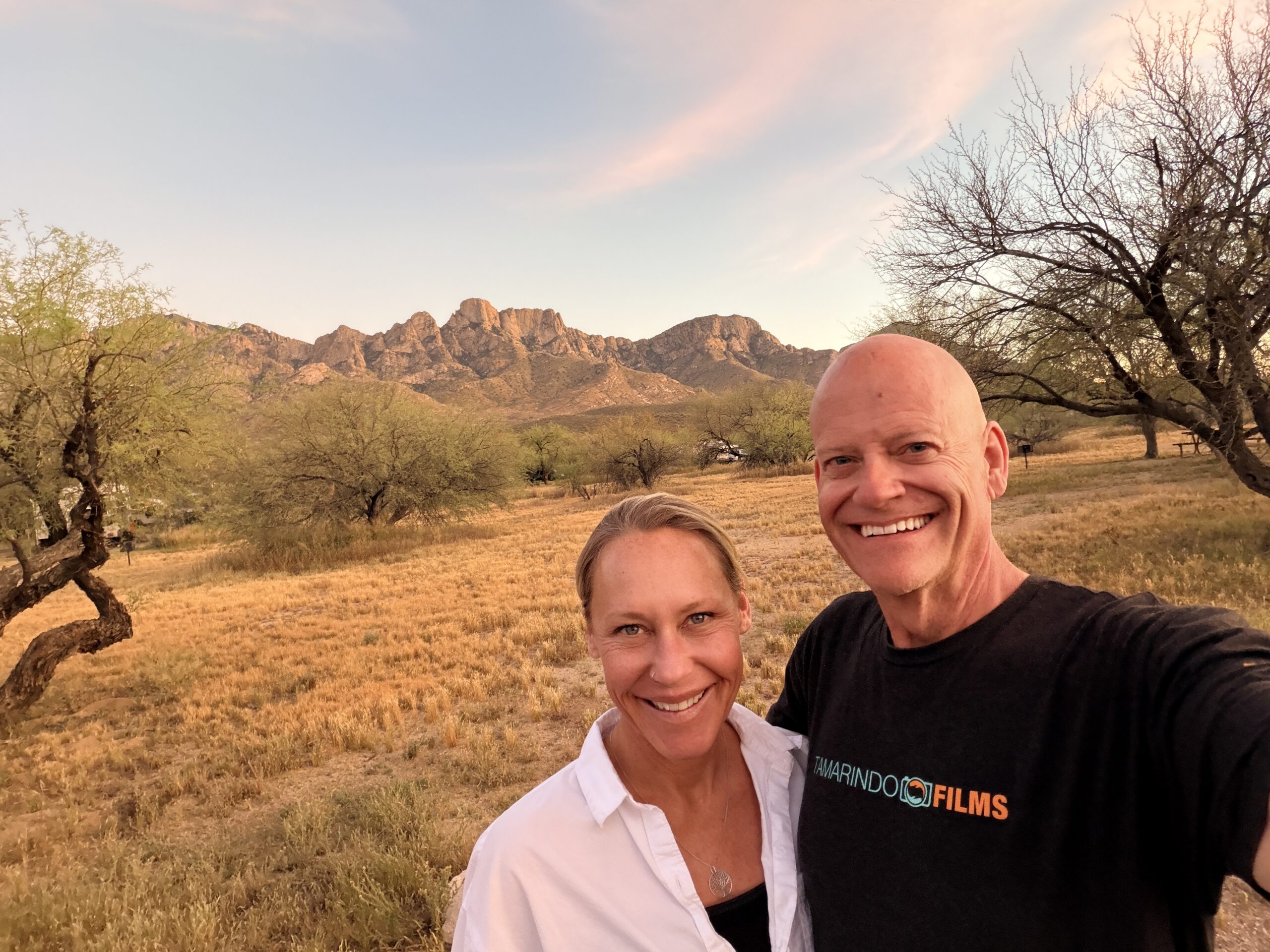
I had never seen a saguaro in real life until we pulled into Catalina State Park on the north edge of Tucson. Then they were everywhere. It was really hot, and it was beautiful. The park is huge and the hiking was incredible, and it’s now one of our favorite campgrounds anywhere.
Arizona was also where we learned that two states right next to each other can charge very differently for the same kind of night. Our six nights in Arizona state parks came to about $50 a night, and our eleven nights in New Mexico state parks came to about $35. The gap is mostly the fee schedule. The three Arizona parks we used charge $50 a night for a hookup site (one where you plug into the park’s power and water), while a non-resident in New Mexico pays $35 for a developed site with water and electric.
We camped in nine state parks across the two states between the fall of 2025 and the spring of 2026. Villanueva was a single night on our first big trip in the Brinkley, our travel trailer, from Colorado to Austin. Most of the rest came in March on the drive from Austin back to Colorado, and the last three came on our spring loop. Below is what each park was like and why the two states cost so differently, with a quick look at what they cost near the end. It’s the same year behind what a year on the road actually cost us.
What is each park known for?
Arizona: a secret cave and the best sunsets we’ve seen
Catalina sits at the base of the Santa Catalina Mountains, and Arizona State Parks says it holds thousands of saguaros and more than 150 bird species. If you’re hiking the Romero Canyon Trail with a dog, note that dogs aren’t allowed past Montrose Pools, in the bighorn sheep area.
We skipped the cave at Kartchner Caverns. I’m very claustrophobic, so going underground wasn’t a priority, and we only had one night there on the way to Catalina. I would have liked to stay longer, though, because it’s a beautiful park. Kartchner is south of Benson and protects a living limestone cave you can only see on a guided tour. Gary Tenen and Randy Tufts found it in 1974 and kept it secret for four years. The Big Room Tour runs only from mid-October to mid-April, because a colony of bats raises its young there in summer. (If you do go underground, pets aren’t allowed on the tours.)
We were at Lost Dutchman State Park in April, and it was stunning. It had the best sunsets we’ve seen anywhere, and the trick is that you don’t look at the sun. You look at the rocks it’s shining on. The campground is small but really cool, and there are lots of nice hiking trails. The park is at the foot of the Superstition Mountains about 40 miles east of Phoenix, and it’s named for the legend of the Lost Dutchman’s Mine. The Treasure Loop is a short one, under two and a half miles round trip, and trails lead on into the Superstition Wilderness. Summer there often tops 100 degrees, and the park says to carry at least a gallon of water per person per day.
New Mexico, from a locked gate to one park I’d skip
Rockhound State Park near Deming was the first park in the country to allow collecting rocks for personal use, and each visitor can take up to 15 pounds. Common finds include quartz crystals and geodes. We didn’t take any rocks home, unless you count the dirt stuck in our tires and on our feet that ended up on the RV floor. A big dust storm came through while we were there. It was cool to see, but it made it hard to be outside.
City of Rocks State Park, between Silver City and Deming, is about a square mile of volcanic rock pinnacles up to 40 feet tall, lined up like city streets. Campsites are tucked in among the rocks, and there’s an observatory for stargazing. We moved sites for our last night there.
Bottomless Lakes State Park, southeast of Roswell, isn’t actually bottomless. It’s a chain of eight lakes that are really sinkholes, the deepest about 90 feet. Back in the 1930s it became the first state park in New Mexico. If you camp at Lea Lake like we did, note that fishing isn’t allowed there.
Villanueva State Park was our first New Mexico state park, and we made it through the gate about ten minutes before it locked. All night I kept dreaming about what would happen if I had to leave. Turns out it was one of those one-way tire-spike gates: you could get out, just not back in. The park itself is very pretty, with lots of hiking and a nice cool river, though the campground is very small and kind of dark. It sits in a canyon of sandstone bluffs along the Pecos River, between I-40 and I-25 in northern New Mexico.
I’ll be honest about Leasburg Dam State Park: I wouldn’t recommend it. When we were there it was all under construction and dry, with no dump station and no services. It was a big mess. The park is on the Rio Grande about 25 minutes north of Las Cruces, built around an irrigation dam from the early 1900s, and its observatory opens for monthly night sky programs.
Sugarite Canyon State Park, just outside Raton, was our stop right before we got back to Colorado, and it was beautiful. It’s another canyon, and it felt a lot like Oak Creek. We did lots of great hiking and a lot of long bike rides, on the road and on the trails. The park sits well above 6,000 feet and has about 20 miles of trails, including one through the ruins of an old coal camp. Heads up for RVers: hookups are limited. Across its two campgrounds there are eight water and electric sites and two full-hookup sites, all 30 amp.
Why did Arizona cost about $50 a night and New Mexico about $35?
Arizona keeps it simple. Arizona State Parks lists $50 a night for a hookup site at all three parks we used, plus a reservation fee of a few dollars per site. That’s exactly what we paid. Arizona’s camping fee also includes park entrance for the length of your stay, so there was no separate entrance charge.
New Mexico charges by the piece, and as Colorado residents we pay the non-resident rates:
- Developed campsite: $20 a night ($15 for New Mexico residents)
- Water hookup: $5 a night
- Electric hookup: $10 a night
- Reservation fee: a few dollars a night, capped at $10 per reservation
A site with water and electric comes to $35 a night, and the reservation fee goes to the booking system, not the parks. Most of our New Mexico stays landed right around $40 a night once that fee was in. City of Rocks and Villanueva came in lower, and that pulls the average down to about $35.
So the difference comes to about $15 a night, even though we paid New Mexico’s non-resident prices.
Is an annual pass worth it in Arizona or New Mexico?
Not for the way we camp. Arizona sells a $200 annual pass, but its reservation policy says annual entrance permits aren’t credited to camping fees. Camping already includes entrance anyway, so it wouldn’t have saved us anything.
New Mexico sells an Annual Camping Permit for $600 to non-residents ($300 for residents), and New Mexico State Parks says it covers the base camping fee. At the $20 non-resident base rate, you’d need 30 nights in New Mexico state parks to break even. We did about a third of that. The FAQ doesn’t say the permit covers hookup fees either, so check before you count on it.
And my federal Access Pass is no help in either state’s parks. It only works at federal sites, and New Mexico State Parks says outright that federal discount passes aren’t accepted.
Which Arizona and New Mexico state parks did we stay at?
Here’s the short version, with reservation fees in:
| State | Nights | Roughly a night |
|---|---|---|
| Arizona (three parks) | 6 | about $50 |
| New Mexico (six parks) | 11 | about $35 |
A few of our stops in these two states weren’t state parks, so they’re not in those numbers:
- Valley of Fires, a Bureau of Land Management recreation area near Carrizozo, New Mexico: two nights in October 2025, about $35 a night.
- Pine Flat Campground in Oak Creek Canyon, Coconino National Forest: four nights in April 2026, under $20 a night with my Access Pass discount.
- Rio Verde RV Park in Cottonwood, Arizona, a private park: three nights in April 2026.
All of them have their own page on our travel map.
Questions people ask
How much does it cost to camp at an Arizona state park?
At the three parks we used, Arizona State Parks charges $50 a night for a site with hookups, plus a reservation fee of a few dollars per site. Camping includes park entrance for your stay. Our six nights came to about $50 a night.
What do New Mexico state parks charge non-residents for camping?
A developed site is $20 a night for non-residents and $15 for New Mexico residents. Hookups are extra, and water plus electric brings a non-resident site to $35 a night. Reservations through the state’s booking system add a few dollars a night, up to $10 per reservation.
Is the New Mexico Annual Camping Permit worth it?
Only if you camp there a lot. It’s $600 for non-residents and $300 for residents, and it covers the base camping fee. A non-resident would need about 30 nights at the $20 base rate to break even.
Does the America the Beautiful pass work at Arizona or New Mexico state parks?
No. Federal passes, including the Access Pass, only work at federal sites. New Mexico State Parks states that federal discount passes are not accepted.
How long can you stay at a New Mexico state park in winter?
From October 1 to April 30, New Mexico State Parks allows up to 14 days in any 20-day period. From May 1 to September 30, the limit drops to 7 days in any 20-day period.
See you down the road,
Matt