Cheap RV Camping on Federal Land: What We Paid in a Year
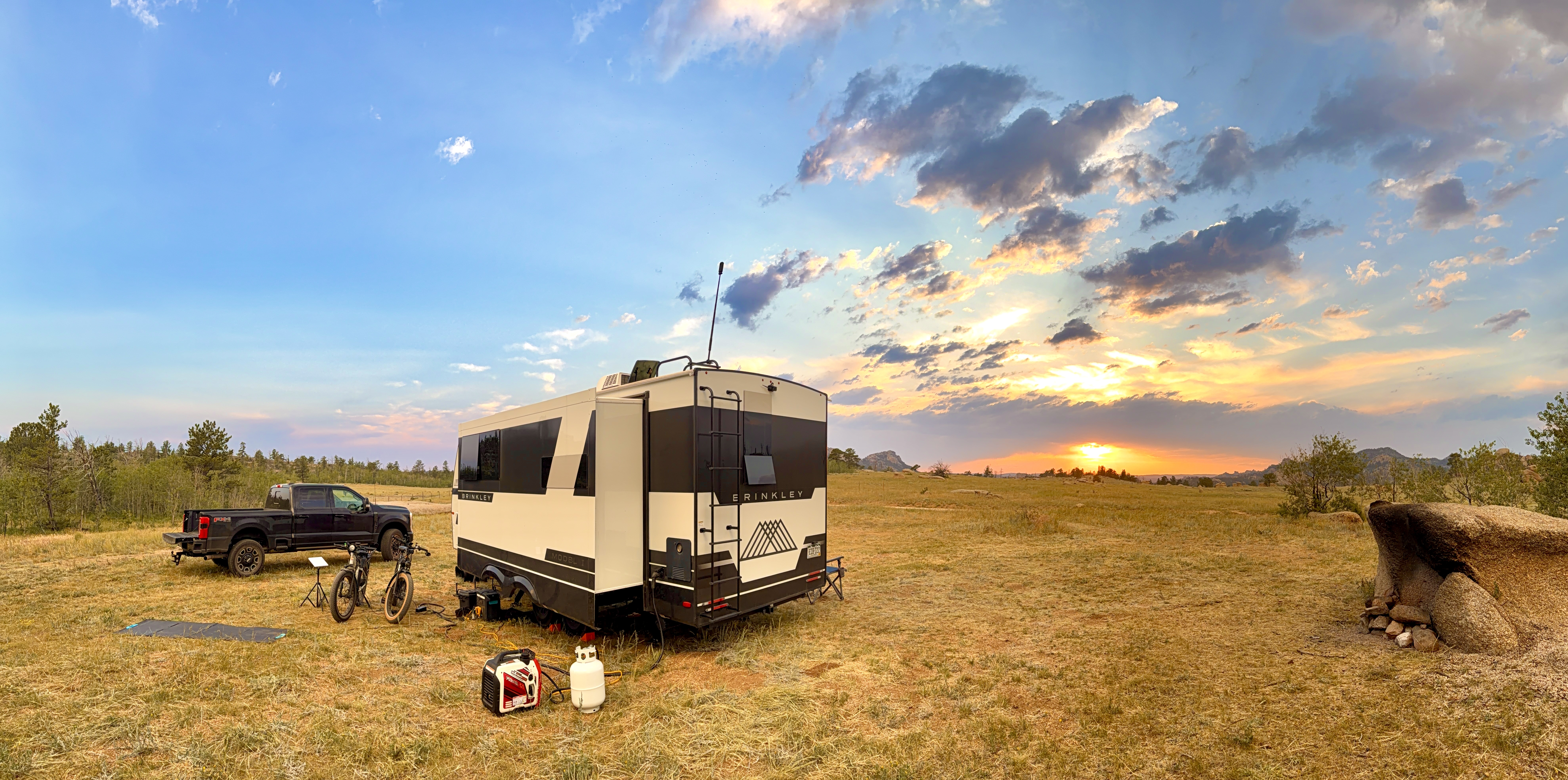
One of my favorite stays of all time cost us nothing. It was a forest road in Wyoming, and on the first night we parked facing the wrong way into a very windy evening. So we hitched the truck back up and turned the trailer to face due west. That got us the most epic sunsets.
That was federal land, and it turned out to be the cheapest camping we found in our whole first year on the road, at around $16 a night on average. With my Access Pass taking half off the campsite fee, our three cheapest stays all came in under $15 a night, which is less than we paid at any state park.
I only noticed when I added up our year for what a year on the road actually cost us. So here’s what camping on federal land was really like, and what you get for the money (spoiler: usually a vault toilet and a view). Every stop is listed near the end.
Who runs these campgrounds, anyway?
When I say federal land, I mean campgrounds run by the national government instead of a state or a private owner. In our first year in the Brinkley, our travel trailer, that meant three agencies:
- The Bureau of Land Management (BLM), five stays
- The Forest Service, three stays
- The National Park Service, one stay
The card in my wallet that cut our camping bill in half
Part of the low cost is that these campgrounds are simple, with hardly any hookups to pay for. Mostly, though, it’s a card in my wallet. In January 2026 I got a lifetime Access Pass (the whole story is in my Access Pass for tinnitus post). Every federal campground we booked after that knocked exactly half off the campsite fee.
You can see it in our own nights. Our two federal stops before the pass, in the fall of 2025, ran about $25 a night. The ones we booked with it in 2026 came to about $12. That’s not a perfect comparison, since our Valley of Fires nights were on electric sites, but it’s close to half, which is what the pass promises.
The fine print is in that other post, and it matters. The discount only comes off the campsite fee, and each campground decides whether to honor it.
Is federal land always cheaper than a state park?
Not without the pass, at least not for us. Before I had it, our federal stops ran about $25 a night, which is right about what Texas state parks cost us (with some help from a $70 state parks pass). So if you don’t qualify for an Access Pass, federal campgrounds are still good value. They just aren’t automatically the cheapest thing on the map.
Here’s roughly what a night cost us, by where we slept:
| Where we slept | Roughly a night |
|---|---|
| Federal land | around $16 |
| Texas state parks | about $25 |
| New Mexico state parks | about $35 |
| Colorado state parks | about $35 |
| Arizona state parks | about $50 |
| Private RV parks | about $75 |
What you actually get at a federal campground
Mostly, you get a quiet site and not much else. Most of the federal campgrounds we stayed at had vault toilets and no hookups, so water and power were on us. We learned that on our very first trip (it’s in Episode 1). There was no shore power in Rabbit Valley, so we experimented, and the result was a solar controller beeping at us at 5 a.m.
A few things I’d tell anyone pulling a trailer onto federal land for the first time:
- Bring water. Sand Gulch has none, and the BLM says to bring your own to Penitente Canyon in case the well is out.
- Check that your rig fits. Hovenweep’s campground was designed mainly for tents, with only a few sites that take RVs. Pine Flat can’t take wide-body motorhomes.
- Read the generator rules. Pine Flat allows no generators during quiet hours.
- Book on Recreation.gov. Pine Flat and Heaton Bay take reservations there. So does Rabbit Valley, and Sand Gulch has some reservable sites (the rest are first come, first served).
Stay limits are worth a look too. They run from 7 days at Pine Flat to 16 days at a single site on Forest Road 700. Rabbit Valley caps you at 7 nights a month. Every place sets its own, so check before you plan a long stay.
Here’s what the official pages say about each stop:
| Campground | Hookups | Drinking water | Stay limit |
|---|---|---|---|
| Pine Flat | None | Yes | 7 days |
| Penitente Canyon | Not listed | May to October | 14 days |
| Sand Gulch | None | None | 14 days |
| Hovenweep | None | Seasonal | Not listed |
| Rabbit Valley | None for us | Not listed | 7 nights a month |
| Valley of Fires | Water and 30/50 amp at RV sites | Yes | 14 days |
| Heaton Bay | Electric at some sites, extra fee | Yes | Not listed |
| Forest Road 700 | None | None | 16 days at one site |
Is there free RV camping on federal land?
Yes, and that windy Wyoming road is where we did it. Over the Fourth of July in 2026, wildfires closed our plan at Rabbit Valley, so we headed north instead and camped on Forest Road 700 in the Medicine Bow National Forest. It’s the Vedauwoo Road, north of Interstate 80 between Laramie and Cheyenne.
Those six nights were pure boondocking (camping with no hookups at all). The road gets some traffic during the day, but when I say heavy I mean maybe 30 or 40 cars all day. We got there a couple of days before the Fourth, and I’m glad we did, because it got busy. It also looked like some people were living out there semi-permanently.
The Forest Service calls it designated dispersed camping. You camp only at marked, numbered sites on a first come, first served basis, and there’s no fee. There are also no services at all, not even toilets or water. You pack out every bit of trash. Your trailer has to stay within 50 feet of the site marker, and the road is closed to vehicles from February through May depending on weather.
Free is great, but it isn’t the same as cheap. With no hookups and no water, a free site is only as good as your tanks and your batteries. We still had our old batteries that week, so we ran the generator a lot (annoying). I can’t wait to go back, though. We’ve already been to Rabbit Valley three times, but if you asked me which federal stop I’d go back to first, it’s Forest Road 700, no question.
Every federal stop from our first year
Here’s the whole list. Our Fourth of July stretch on Forest Road 700 was free, so it sits outside the average. The cheapest paid stay was Penitente Canyon at under $10 a night, and the priciest was Valley of Fires at about $35, on an electric site and before the pass.
- Rabbit Valley, McInnis Canyons, Colorado (BLM): September 2025, and one more night in September 2026
- Valley of Fires, New Mexico (BLM): October 2025
- Pine Flat, Arizona (Forest Service): April 2026
- Forest Road 700, Wyoming (Forest Service): July 2026, free
- Penitente Canyon, Colorado (BLM): August 2026
- Hovenweep, Utah (Park Service): September 2026
- Sand Gulch, Colorado (BLM): September 2026
We also spent one night at Heaton Bay on Dillon Reservoir in September 2025, on one of our very first trips in the Brinkley.
Questions people ask
Is camping on BLM land free?
Some of it is, but the developed BLM campgrounds we used all charged a nightly fee. Penitente Canyon and Sand Gulch both have camping fees. Since February 2023, overnight camping in Rabbit Valley has been in developed campgrounds reserved through Recreation.gov.
Does the Access Pass work at federal campgrounds?
At many of them, yes. At every federal campground we booked after January 2026, it took half off the campsite fee. Each campground decides whether to honor it, and it doesn’t work at state parks at all.
Do federal campgrounds have hookups?
Most of the ones we stayed at did not. Valley of Fires in New Mexico was the big exception, with water and 30 or 50 amp electric at its RV sites. Heaton Bay offers electric at some sites for an extra fee.
How long can you stay at a federal campground?
It depends on the campground. Pine Flat allows 7 days, and Sand Gulch allows 14. On Forest Road 700 it’s 16 days at one site. Check the official page for each place before you go.
How much does federal camping cost per night?
For us it averaged around $16 a night, with an Access Pass for most of them. Our two federal stops before the pass ran about $25 a night. Developed campgrounds charge a fee, while designated dispersed sites like Forest Road 700 are free.
See you down the road,
Matt